
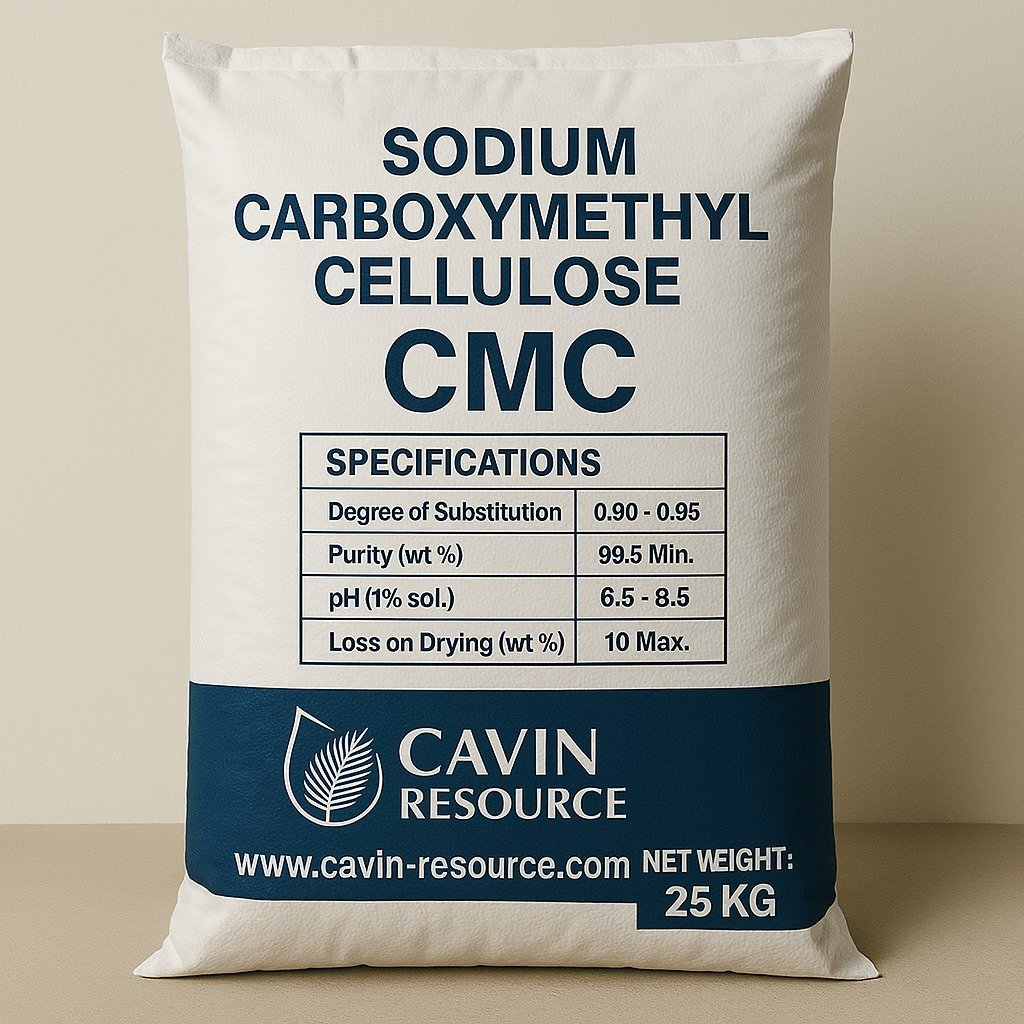
Carboxyméthylcellulose sodique (CMC) - Liant à haute viscosité
Bulk Buy Sodium Carboxymethyl Cellulose (CMC) is a versatile water-soluble polymer widely used as a thickening agent, stabilizer, binder, et emulsifier in industries such as food, pharmaceuticals, textiles, ceramics, and oil drilling. Cavin Resource supplies high-purity CMC in bulk, customizable for various viscosity grades and applications.
Prix de la carboxyméthylcellulose sodique
Sodium Carboxymethyl Cellulose (CMC) est un cellulose derivative created through the chemical modification of natural cellulose. It functions as an effective rheology modifier, water retention aid, et emulsion stabilizer. Known for its high solubility in cold and hot water, CMC delivers consistent performance in a wide range of industries including food processing, oil and gas, ceramics, construction, paints, detergents, et paper manufacturing. Sodium carboxymethyl cellulose price per ton
Ressource Cavin offers industrial, food-grade, and technical-grade CMC in bulk quantities, manufactured under strict quality standards. We ship globally and cater to the custom formulation needs of manufacturers and wholesale buyers. sodium carboxymethyl cellulose suppliers
⚙️ Méthode de production
1. Alkalization
Cellulose is treated with sodium hydroxide (NaOH) to produce alkali cellulose.
2. Etherification
Alkali cellulose reacts with monochloroacetic acid to form sodium carboxymethyl cellulose.
3. Purification & Drying
Product is neutralized, filtered, dried, and milled into a fine white powder.
🏭 Applications et cas d'utilisation dans l'industrie
🥣 Food & Beverage Industry
Acts as a thickener, stabilizer, et fat replacer in products like sauces, ice cream, yogurt, and bakery fillings.
💊 Produits pharmaceutiques
Utilisé comme tablet binder et controlled-release agent in drugs and syrups.
🧪 Oil Drilling & Mining
Serves as a viscosity modifier et fluid loss reducer in drilling fluids and fracturing operations.
🏗️ Construction & Ceramics
Enhances plasticity, water retention, et adhesion in tile adhesives, mortars, and ceramic slurries.
🧼 Detergents & Cosmetics
Used to suspend solids, improve texture, and prevent ingredient separation in liquid formulations.
✅ Benefits of Sodium Carboxymethyl Cellulose (CMC)
🌊 Excellent water solubility and thickening ability
💧 Improves moisture retention and texture
🧪 Chemical stability across pH and temperature ranges
🌍 Biodegradable and environmentally friendly
🔄 Compatible with many other polymers and additives
📦 Options d'emballage
25 kg kraft paper bags with inner plastic lining
500 kg or 1-ton jumbo bags available for bulk orders
Custom packaging and labeling upon request
Includes full COA, MSDS, and export documentation
❓ Foire aux questions (FAQ)
1. Is CMC safe for food applications?
Réponse : Yes, our food-grade CMC complies with FAO/WHO Codex, E number E466, and is approved by FDA and EU regulations.
2. What viscosity grades do you offer?
Réponse : We supply a broad range of viscosity grades (25–10,000 cps) to suit various industrial and food-specific applications.
3. How should CMC be stored?
Réponse : Store in a cool, dry place away from moisture. Seal bags tightly after use to maintain product integrity.
4. Can you ship globally?
Réponse : Yes, Cavin Resource provides international shipping with all export-compliant documentation included.
📚 Sources crédibles pour le référencement et la référence
Informations complémentaires
| Nom du produit | Sodium Carboxymethyl Cellulose (CMC) |
|---|---|
| Numéro CAS | 9004-32-4 |
| Code SH | 3912310000 |
| Molecular Formula | C8H15NaO8 |
| Apparence | White to off-white powder |
| Grade Available | Food-grade, industrial-grade, pharma-grade |
| Viscosity Range | 25 – 10,000 cps (1% solution) |
| La pureté | ≥ 99% |
| Solubilité | Soluble in water |
| Emballage | 25 kg bags, jumbo bags |
| Durée de conservation | 24 mois |
| Applications | Food, pharma, oil drilling, ceramics, paints |
| Conformité | ISO, FDA, EFSA, Codex, REACH |
| Origine | Available upon request |
Produits apparentés
-
Vente !

Isopropyl Alcohol (C₃H₈O) – Bulk & P2P Supply for Industrial, Medical & Cosmetic Use
Le prix d'origine était : $750.00.$700.00Le prix actuel est : $700.00. -
Vente !
Éthylène glycol - Liquide de refroidissement de qualité industrielle
Le prix d'origine était : $550.00.$500.00Le prix actuel est : $500.00. -
Vente !
Propylene Glycol – USP/Industrial Grade Solvent
Le prix d'origine était : $2,100.00.$200.00Le prix actuel est : $200.00. -
Vente !
Acide méthacrylique (MAA) - Monomère acrylique de haute pureté
Le prix d'origine était : $1,900.00.$1,800.00Le prix actuel est : $1,800.00.


 English
 Français
 Português
 Deutsch (Sie)
 Español
 Türkçe
 简体中文
简体中文 Nederlands
 Svenska
 Tiếng Việt
 Afrikaans
 Čeština
 Bahasa Indonesia
 Irish
Irish Suomi
Suomi עִבְרִית
 Luxembourgish
 Latin
Latin Bahasa Melayu
 فارسی
فارسی Norsk bokmål
 ไทย
ไทย Cymraeg
Commentaires
Il n'y a pas encore de commentaires.