

utilisations industrielles de l'acétone
L'acétone est l'un des solvants industriels les plus utilisés dans le secteur manufacturier mondial. Son pouvoir solvant exceptionnel, sa vitesse d'évaporation rapide et sa compatibilité avec de nombreux matériaux en font un produit chimique essentiel pour un large éventail d'applications industrielles.
De la production pharmaceutique et de la fabrication de composants électroniques aux peintures, revêtements, plastiques et adhésifs, l'acétone aide les entreprises à améliorer leur efficacité, la qualité de leurs produits et leurs performances de production.
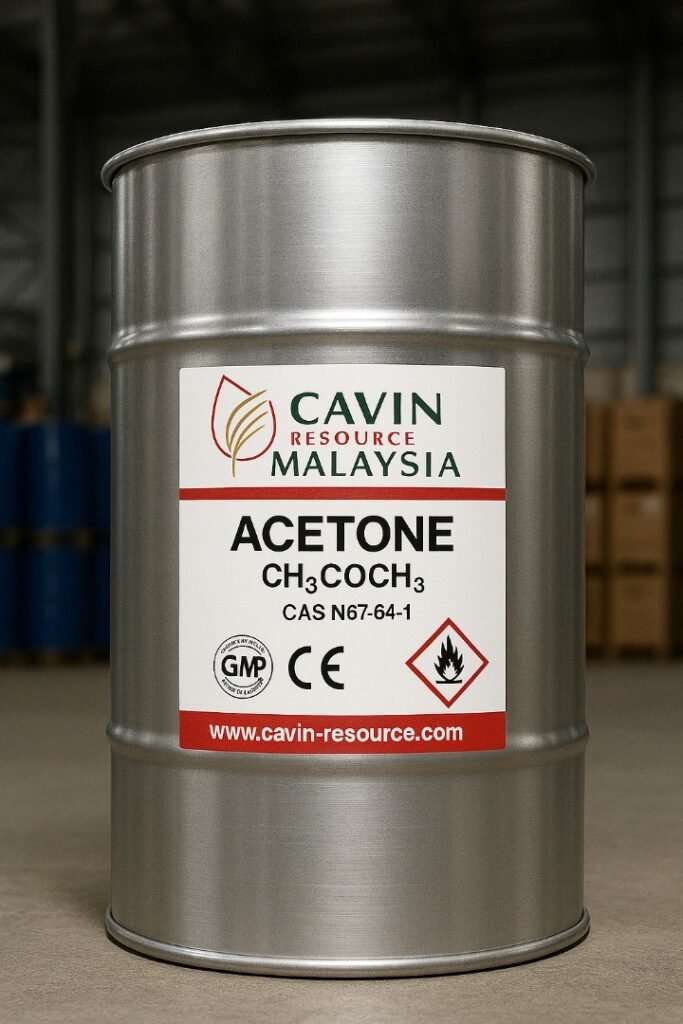
En tant que fournisseur de produits chimiques industriels de confiance, Ressource Cavin fournit de l'acétone de haute pureté aux fabricants et aux utilisateurs industriels à la recherche de solutions de solvants fiables pour des applications exigeantes.
Pourquoi l'acétone est largement utilisée dans l'industrie
Les acheteurs industriels choisissent l'acétone car elle offre plusieurs avantages par rapport à de nombreux solvants alternatifs.
Les principaux avantages comprennent :
- Fort pouvoir solvant
- Évaporation rapide
- Faible résidu après séchage
- Miscibilité à l'eau
- Rapport coût-efficacité
- Large compatibilité industrielle
Ces caractéristiques rendent l'acétone adapté tant aux processus de fabrication qu'aux opérations de nettoyage industriel.
L'acétone dans la fabrication des peintures et des revêtements
L'un des plus grands usages industriels de l'acétone se trouve dans l'industrie des peintures et des revêtements.
L'acétone agit comme un solvant qui aide les fabricants à obtenir la consistance et les propriétés d'application souhaitées dans des produits tels que :
- Peintures
- Vernis
- Laques
- Revêtements de protection
- Peintures automobiles
Comme l'acétone s'évapore rapidement, elle aide les revêtements à sécher plus vite tout en préservant la qualité et l'apparence du produit.
Avantages pour les fabricants de peinture
- Des cycles de production plus rapides
- Performance améliorée du revêtement
- Caractéristiques améliorées de l'application
- Nettoyage efficace des équipements
L'acétone dans la fabrication pharmaceutique
L'industrie pharmaceutique dépend fortement de l'acétone lors du développement et de la production de médicaments.
L'acétone est fréquemment utilisée comme solvant de traitement dans la synthèse, la purification et la formulation de composés pharmaceutiques.
Les applications comprennent :
- Production de principe actif pharmaceutique
- Synthèse chimique
- Nettoyage du matériel
- Opérations de laboratoire
- Procédés d'extraction par solvant
Sa haute pureté et son évaporation rapide le rendent particulièrement utile dans les environnements pharmaceutiques où le contrôle de la contamination est critique.
L'acétone dans la production de plastiques et de polymères
L'acétone joue un rôle important dans l'industrie des plastiques et des polymères.
Les fabricants utilisent de l'acétone lors de la production de :
- Plastiques en polycarbonate
- Plaques en acrylique
- Plastiques techniques
- Fibres synthétiques
- Composants en plastique
Ce produit chimique est également utilisé pour la préparation des surfaces et le nettoyage lors des processus de fabrication.
Alors que la demande mondiale de polymères avancés continue de croître, l'acétone reste un produit chimique de soutien important tout au long de la chaîne de production.
Acétone dans les adhésifs et les mastics
L'industrie des adhésifs utilise l'acétone à la fois comme solvant et comme agent de formulation.
Il aide les fabricants :
- Contrôler la viscosité
- Améliorer l'efficacité du mélange
- Améliorer la cohérence des produits
- Prise en charge de la performance des applications
De nombreux adhésifs industriels nécessitent des solvants qui s'évaporent rapidement sans affecter la résistance finale du collage. L'acétone répond efficacement à ces exigences.
Acétone dans la fabrication électronique
La fabrication de l'électronique moderne nécessite des surfaces et des composants extrêmement propres.
L'acétone est largement utilisée pour éliminer :
- Huiles
- Graisse
- Résidus de flux
- Contaminants de surface
- Résidus de fabrication
Comme l'acétone s'évapore rapidement, elle minimise la rétention d'humidité et les risques de contamination.
Les applications comprennent :
- Nettoyage de cartes électroniques
- Préparation des composants
- Maintenance des équipements de précision
- Nettoyage de la ligne de production
Acétone dans le nettoyage industriel et le dégraissage
Le nettoyage industriel représente une autre utilisation majeure de l'acétone.
De nombreuses usines de fabrication utilisent de l'acétone pour éliminer :
- Huiles
- Lubrifiants
- Graisse
- Résidus de colle
- Contaminants de surface
Son efficacité en tant que solvant dégraissant le rend précieux dans :
- Construction automobile
- Fabrication métallique
- Maintenance des machines
- Entretien du matériel
Un nettoyage adéquat contribue à améliorer l'efficacité opérationnelle et la qualité des produits.
Acétone dans la fabrication chimique
L'acétone est également utilisée comme intermédiaire chimique dans la production de nombreux produits industriels.
Ceux-ci comprennent :
- Plastiques
- Solvants
- Matériaux synthétiques
- Produits chimiques de spécialité
- Formulations industrielles
Son rôle dans le traitement chimique contribue de manière significative aux chaînes d'approvisionnement de la fabrication moderne.
L'acétone dans la recherche et les applications de laboratoire
Les laboratoires de recherche dépendent de acétone à diverses fins.
Les applications de laboratoire courantes comprennent :
- Nettoyage de la verrerie
- Préparation des échantillons
- Analyse chimique
- Surface cleaning
- Equipment maintenance
Its versatility and availability make it a standard solvent in scientific environments. industrial uses of acetone
Industries That Use Acetone
Acetone supports operations across numerous sectors, including:
Industrie pharmaceutique
Drug development and production.
Automotive Industry
Surface preparation, coatings, and cleaning.
Paint and Coatings Industry
Formulation and manufacturing.
Electronics Industry
Cleaning and assembly operations. industrial uses of acetone
Chemical Manufacturing Industry
Processing and synthesis applications.
Plastics Industry
Polymer and component production.
Research Laboratories
Testing and analytical procedures. industrial uses of acetone
Industrial Maintenance
Cleaning and equipment servicing.
Why Manufacturers Prefer Acetone
Manufacturers continue to rely on acetone because it provides a balance of performance, availability, and cost-effectiveness.
Advantages include:
- Strong solvent performance
- Rapid drying
- Reduced production downtime
- Excellent cleaning efficiency
- Broad application range
- Reliable global supply
These benefits help businesses optimize operations while maintaining product quality standards. industrial uses of acetone
Choosing a Reliable Acetone Supplier
The quality of industrial acetone can directly impact manufacturing outcomes. industrial uses of acetone
When selecting a supplier, businesses should consider:
Product Quality
Consistent purity and performance.
Supply Reliability
Ability to meet ongoing production requirements.
Technical Documentation
Access to SDS, COA, and compliance information.
Logistics Support
Efficient delivery and inventory management.
Industry Experience
Knowledge of industrial solvent applications.
Cavin Resource supports manufacturers with dependable acetone supply solutions tailored to industrial requirements across multiple sectors.
Foire aux questions
What are the industrial uses of acetone?
Acetone is used in paints, coatings, pharmaceuticals, plastics manufacturing, adhesives, electronics cleaning, laboratory operations, and chemical production. industrial uses of acetone
Why is acetone used in manufacturing?
Its strong solvency, rapid evaporation, and cost-effectiveness make it suitable for numerous industrial processes.
Which industries use the most acetone?
Pharmaceutical, coatings, plastics, electronics, automotive, and chemical manufacturing industries are among the largest users.
Is acetone used in pharmaceutical manufacturing?
Yes. Acetone is commonly used in drug synthesis, purification, and production processes.
Can acetone be used for industrial cleaning?
Yes. Acetone is widely used for degreasing, equipment cleaning, and surface preparation. industrial uses of acetone
Why is acetone important in electronics manufacturing?
It removes contaminants and residues while evaporating quickly, reducing contamination risks. industrial uses of acetone
Is acetone used in plastic production?
Yes. Acetone supports the manufacture of various plastics, polymers, and acrylic materials.
What should companies look for in an acetone supplier?
Product quality, supply reliability, technical documentation, logistics support, and industry expertise are all important considerations.
Conclusion
Acetone remains one of the most important industrial solvents in the world. Its widespread use across pharmaceuticals, coatings, plastics, electronics, adhesives, and chemical manufacturing demonstrates its value in modern industry.
As manufacturing processes continue to evolve, businesses require dependable access to high-quality solvents that support productivity, compliance, and product performance. By partnering with experienced suppliers such as Cavin Resource, industrial buyers can secure reliable acetone supply solutions that meet the demands of today’s competitive marketplace. industrial uses of acetone
 English
 Français
 Português
 Deutsch (Sie)
 Español
 Türkçe
 简体中文
简体中文 Nederlands
 Svenska
 Tiếng Việt
 Afrikaans
 Čeština
 Bahasa Indonesia
 Irish
Irish Suomi
Suomi עִבְרִית
 Luxembourgish
 Latin
Latin Bahasa Melayu
 فارسی
فارسی Norsk bokmål
 ไทย
ไทย Cymraeg
 Italiano
0 commentaires